Excavation et ablution
- Janeva L. Fauve
OPENING: Thursday, November 5, from 5:30 p.m.
ABOUT THE EXHIBITION
Words are never in short supply for this artist.
As for wounds, they find a language in her work.
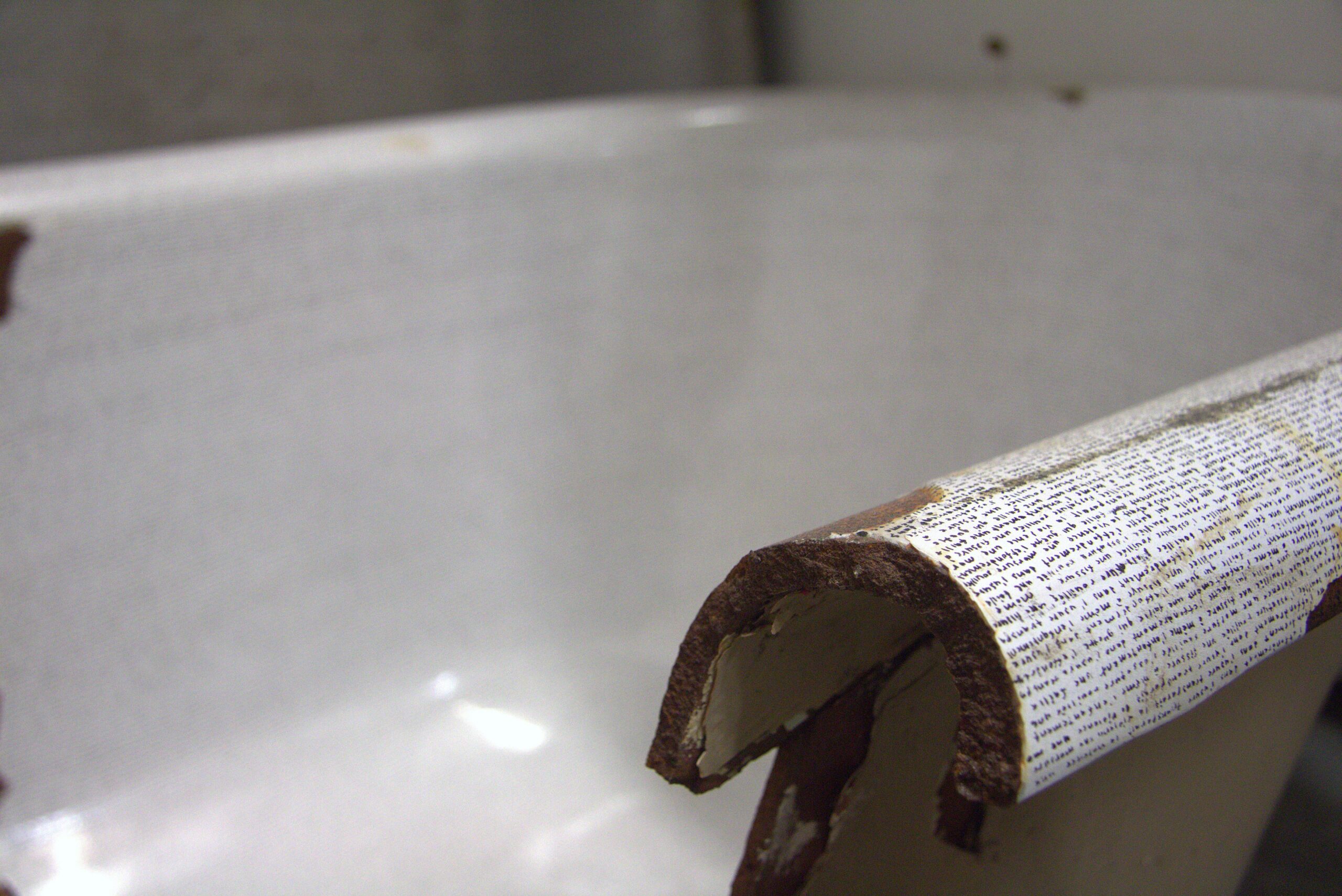
Janeva L. Fauve creates a singular universe, both moving and decisive, in which the poetic embraces the traumatic in a narrative rhythm that is assuredly obsessive, yet ultimately contemplative. In this work, words become material: they cover up, overflow and accumulate, like so many layers on which memory, violence and recollections are inscribed.
Fauve proceeds by collecting domestic objects and fixtures intended for ablution. She deliberately chooses abandoned bathtubs and sinks that she finds here and there, relegated to oblivion in parking lots, on sidewalks, in forests, even in fields. All bear the marks of time: damaged, rusted, sometimes irreparably altered or broken. It is impossible to restore them, let alone return them to their original function.
As Fauve works to make art with these objects, the time-damaged fixtures become powerful metaphors for purification; they evoke through ablution that primal gesture in which the body seeks to get rid of what soils it. But here, the process is diverted and overturned. Water no longer washes away the impurity: it is now words. These words, in obstinately driven repetition, emerge from a performative form of writing that flows down the walls, settles upon them and covers them. Thus, words become fluid and enduring material, a kind of verbal streaming that seeks to purify what water can no longer cleanse. […]
– Excerpt from curatorial text, by Émilie Granjon
About the artist
Janeva L. Fauve is an artist based in Tiohtià:ke (Montréal, QC). Currently, she is completing a Master’s degree in Visual Arts at Université Laval, while also pursuing research in Comparative Literature. Her practice is concerned in particular with the encounter between art and textuality, as well as with the tension between appearance and disappearance. A desire for proximity, attentiveness and intimacy guides her practice in which listening and reading become sites of resistance, more often than not through installation. Through repeated gestures, she creates a relationship with matter, with gathered objects and with her battle-body. She distorts her appearance and conceals herself in order to whisper about opaqueness, meticulously and obsessively setting out the emotive motif; a line written from the invisible to the retina, between memory and survival, between pain and tenderness, symptomatic of the corrosiveness of fear.
Her work has been exhibited in Québec City and Montréal, notably as part of Mois Multi (Québec City, QC, 2025), at Art Mûr (Montréal, QC, 2024) and at the Galerie des Arts visuels (Québec City, QC, 2025). Her practice has also been recognized and supported with a Grant-Mathieu Fund grant (2024), the Garde-Fou Prize from Folie/Culture (2024), a Première Ovation project grant (2024) and a grant from the Royal Canadian Academy of Arts (2025).
About the author
Émilie Granjon holds a DESS in Cultural Organization Management from HEC Montréal, which she obtained in 2015, and has been running the CIRCA Art Actuel artist-run center since May 2016. She is also an essayist and art critic, as well as an independent curator. With a PhD in semiology from UQAM in 2008, she analyzes the cultural issues of current art through the study of unusual figures. In her thesis, she focused on the semiogenesis of alchemical symbolism in Atalanta fugiens (1617), and published Comprendre la symbolique alchimique (PUL: Québec, 2012). In contemporary art, she co-authored with Fabienne Claire Caland Cinq fabricants d’univers dans l’art actuel (Nota Bene: Montréal, 2017) and, more recently, also with Véronique La Perrière M. Le miroir, la métaphore et le temps inversé (Sagamie: Alma, 2020).